Queer Places:
Winchester College, College St, Winchester SO23 9NA, United Kingdom
University of Cambridge, 4 Mill Ln, Cambridge CB2 1RZ
Weybridge Cemetery, Brooklands Ln, Weybridge KT13 8UX, United Kingdom
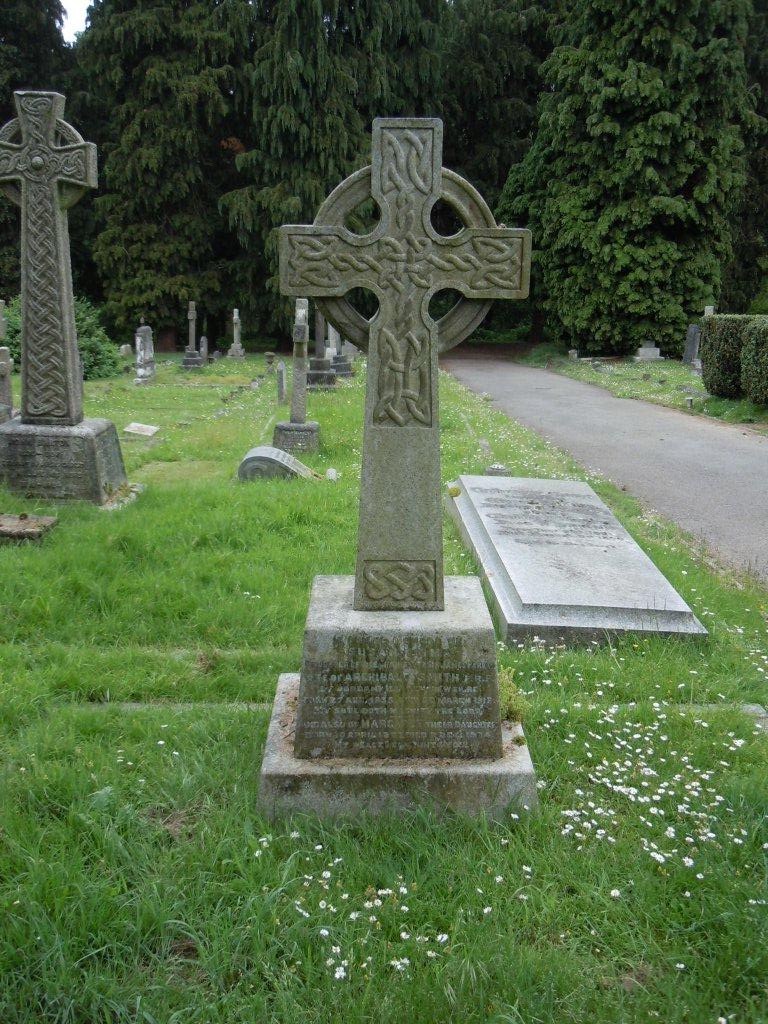 Arthur Hamilton Smith (October 2, 1860 – September 28, 1941) was born on October 2, 1860, as the fourth son of the notable mathematician and barrister Archibald Smith, FRS
(1813–1872), of Riverbank, Putney, and Jordanhill, Renfrewshire, and his wife, Susan Emma Parker Smith (1835–1915). He grew up in an intellectually distinguished family that
included his brothers Sir James Parker Smith and Sir Henry Babington Smith,
both of whom, like Arthur, were members of the prestigious Cambridge Apostles.
Arthur Hamilton Smith (October 2, 1860 – September 28, 1941) was born on October 2, 1860, as the fourth son of the notable mathematician and barrister Archibald Smith, FRS
(1813–1872), of Riverbank, Putney, and Jordanhill, Renfrewshire, and his wife, Susan Emma Parker Smith (1835–1915). He grew up in an intellectually distinguished family that
included his brothers Sir James Parker Smith and Sir Henry Babington Smith,
both of whom, like Arthur, were members of the prestigious Cambridge Apostles.
After receiving early schooling at Dr Spyer's school in Weybridge, Smith attended Winchester College as a scholar from 1874 to 1879. Though initially nominated for the
Indian Civil Service, he chose an academic path instead, entering Trinity College, Cambridge, on October 4, 1879. He achieved a second class in Part I of the Classical
Tripos in 1881 and a first class in Part II in 1883, earning special distinction in archaeology, and completed his BA in 1884 (followed by an MA in 1888).
During his time at Cambridge, Smith was admitted in 1882 to the Cambridge Apostles, an elite and secretive intellectual society historically recognized for fostering
intense homosocial and homoerotic bonds among its members.
Following his graduation, Smith traveled extensively through Greece, Italy, and Sicily in 1884. He subsequently joined an archaeological expedition in Asia Minor with
William Mitchell Ramsay, though he was forced to cut the trip short due to declining health. After traveling to Egypt in 1885, he formally entered the professional sphere of
classical antiquity.
In April 1886, Smith was appointed to the Department of Greek and Roman Antiquities at the British Museum under Sir Charles Newton, serving alongside Alexander Stuart
Murray. He quickly established himself as a preeminent authority on ancient material culture. Together with Murray, he co-authored the Catalogue of Engraved Gems (1888) and
White Athenian Vases (1896). For the latter work, Smith designed an innovative "cyclograph" device to photograph cylindrical surfaces, earning him a gold medal at the Berlin
photographic exhibition in 1896.
Smith's independent scholarship yielded monumental catalogues, including the three-volume Catalogue of Sculpture in the Department of Greek and Roman Antiquities
(1892–1904) and the foundational Guide to the department (first published in 1899). He also cataloged private classical collections, including those at Lansdowne House
(1889), Yarborough (1897), and Woburn Abbey (1900). Between 1893 and 1896, funded by a bequest from Emma Tournour Turner, he participated directly in British Museum
excavations in Cyprus, later publishing the findings alongside Murray and Henry Beauchamp Walters.
Smith became Assistant Keeper of the department in 1904 and succeeded to the role of Keeper from 1909 to 1925. In this capacity, he successfully protected the museum's
priceless collections during the turbulent years of the First World War. To mark the centenary of the acquisition of the Parthenon Sculptures, he published a definitive
defense of Lord Elgin (Lord Elgin and his collection, Journal of Hellenic Studies, 1916) countering the criticisms leveled by Lord Byron and others.
Outside the British Museum, Smith was deeply influential in classical societies. He served on the council of the Society for the Promotion of Hellenic Studies from 1887
onward, acting as joint editor of its journal, librarian, vice-president, and president from 1924 to 1929. He was also vice-president of the Society for the Promotion of
Roman Studies and contributed actively to the Byzantine Research Fund.
Upon retiring from the British Museum in October 1925, Smith directed the British School at Rome between 1928 and 1930, and again in 1932, having previously chaired its
faculty of Archaeology, History, and Letters. His extensive contributions were widely recognized: he was elected a Fellow of the Society of Antiquaries (1893) and the
British Academy (1924), made an Honorary Associate of the Royal Institute of British Architects (1925), and appointed a Companion of the Order of the Bath (CB) in 1926. He
also held corresponding memberships with the German and Austrian archaeological institutes and honorary status in the Art-Workers' Guild.
On April 28, 1897, Smith married Gertrude Prudence Blomfield Jackson (1870–1961), eldest daughter of the Reverend Blomfield Jackson. The couple had one daughter,
Elizabeth Hamilton Smith (1898–1987). They initially lived in Bloomsbury and later resided in an official residence inside the British Museum from 1912 until his retirement.
In 1932, they relocated to Weybridge, Surrey. Smith passed away there on September 28, 1941, at the age of 80, and was interred at Weybridge Cemetery.
References:
Other references:
- Oxford Dictionary of National Biography (ODNB): B. F. Cook, "Smith, Arthur Hamilton (1860–1941)"
- Winchester College Records: Winchester College Register
- Genealogical and Peerage Records: Burke's Landed Gentry (L.G.)
- Contemporary Journalism & Notices: The Times (specifically the obituary notice published on September 30, 1941)
Support this project
This website is a passion project researched, developed, and funded entirely by me. If you find the content valuable and would like to help support the ongoing research and hosting costs, any contribution is deeply appreciated.
Thank you for keeping this independent resource alive!
My books on Amazon: Elisa Rolle's books
BACK TO HOME PAGE
